Tours & Experiences
Sintra Tours from Lisbon: Best Day Tours Compared (2026)
Best Sintra tours from Lisbon compared—small group, premium, private, and self-guided options. Itineraries, prices, and what to expect.

In this guide
- Quick Comparison: Sintra Tour Types
- Why Sintra Deserves a Full Day
- Pena Palace: What You’re Actually Visiting
- Quinta da Regaleira: The Other Essential Stop
- Best Sintra Tour Operators
- What’s Typically Included
- What’s Typically NOT Included
- Tour Itinerary (Typical)
- Tour vs DIY: Which to Choose?
- Getting There: The Logistics Your Tour Handles
- Sintra Food: What to Eat
- Booking Tips
- Combining Sintra with Cascais
- The Moorish Castle and Other Sintra Sights
- What to Eat in Sintra
- Practical Tips for Sintra in 2026
- FAQ: Sintra Tours from Lisbon
- Bottom Line
A guided Sintra tour from Lisbon is the easiest way to do Sintra without managing logistics yourself — multiple operators offer day tours combining Pena Palace, Quinta da Regaleira, and sometimes Cabo da Roca and Cascais in one organized package.
If you would rather organise the day yourself, our Sintra tickets and transport guide shows exactly what a tour is saving you and what it costs to do the same thing independently.
If you would rather build the day yourself than buy it, our complete Sintra guide has every monument, the 2026 gate prices and how the bus and ticket system works independently.
This guide compares the best Sintra tour options for 2026, covers what’s included at the prices operators list, what to expect on the day, and gives you an honest take on whether a tour is actually worth it over the DIY train. Updated for 2026.
Quick Comparison: Sintra Tour Types
| Type | Cost | Duration | Group size | Best for |
|---|---|---|---|---|
| Small-group day tour | €60–€110 | 8 hours | 8–14 | First-time visitors, ease |
| Premium small-group | €110–€160 | 8 hours | 6–8 | Those who want more depth |
| Private full-day tour | €280–€600 | 8–10 hours | 1–4 | Families, special occasions |
| Self-guided package | €40–€60 | Self-paced | N/A | Independent travellers |
Why Sintra Deserves a Full Day
Sintra sits 30km northwest of Lisbon, in the Serra de Sintra — a granite ridge that catches Atlantic clouds and stays cooler than the city even in summer. The palaces here are unlike anything else in Portugal: Pena Palace is a full-scale Romanticist fantasy built by a king who had genuine architectural opinions; Quinta da Regaleira is a neo-Manueline estate with an initiatic well that spirals 27 metres underground to a Templar cross; the Moorish Castle predates the Christian conquest of Lisbon.
UNESCO designated Sintra’s Cultural Landscape a World Heritage Site in 1995. The challenge isn’t whether it’s worth visiting — it obviously is — it’s managing the logistics on a day that involves multiple hilltop palaces, a small historic town, potential queues of 45+ minutes at Pena Palace, and limited transport between sites.
That’s the exact problem a good tour solves.

Pena Palace: What You’re Actually Visiting
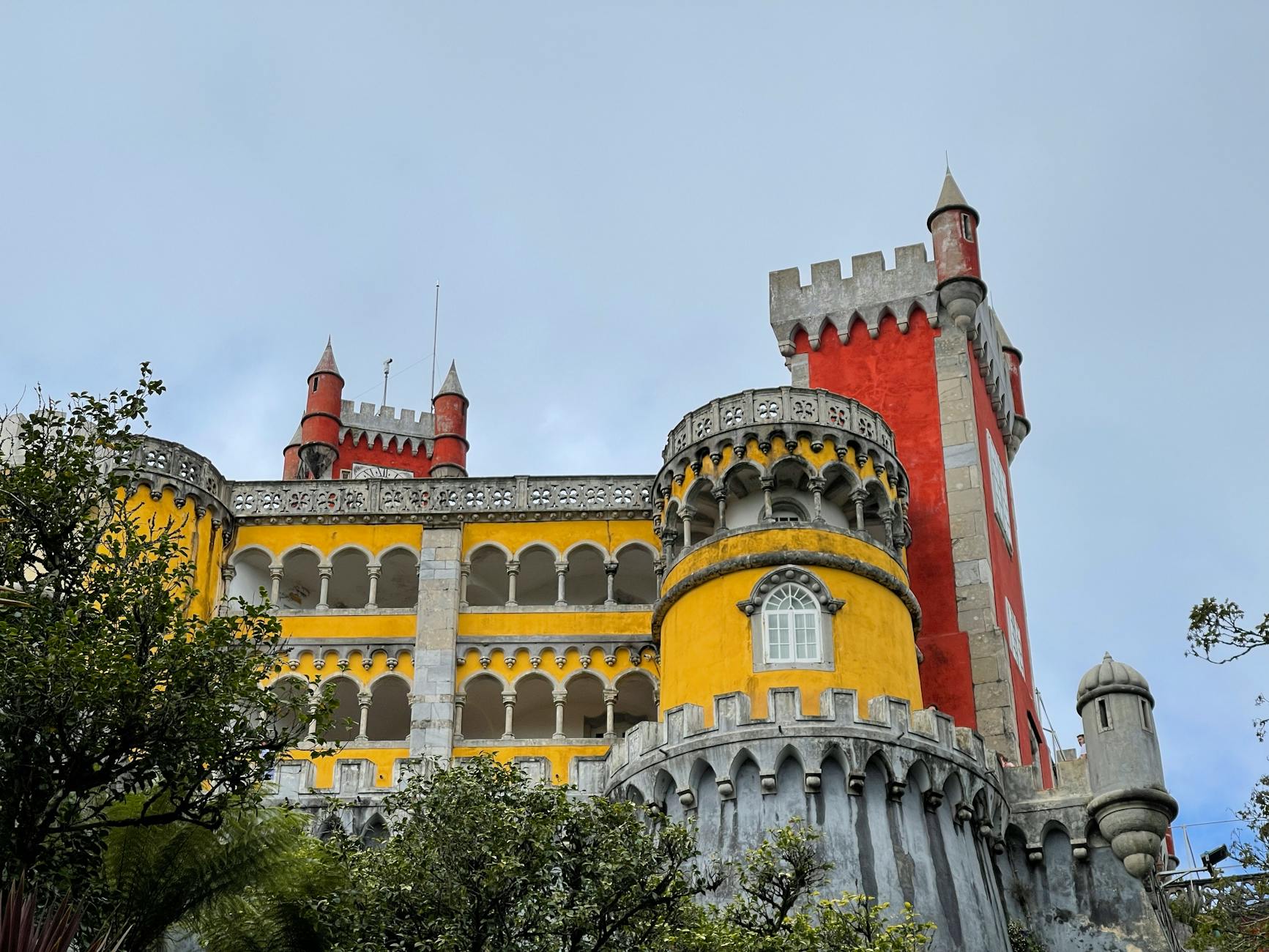
Pena Palace is the anchor attraction. Built between 1842 and 1854 by King Ferdinand II on the ruins of a Hieronymite monastery, it’s a deliberate mash-up of Romanticist architectural styles — Moorish arches, Gothic towers, Manueline stonework, and a colour scheme of ochre and burgundy that looks almost absurd from a distance and completely coherent up close. The views from the battlements on a clear day reach Lisbon and the Tagus estuary.
Current ticket prices (2026, verified from parquesdesintra.pt): park + palace €20 adult, €18 youth/senior; park only €12 adult. The park opens at 9:00 AM, the palace at 9:30 AM. Last ticket sales for the palace are at 5:30 PM and last admission is at 6:00 PM; the park closes at 7:00 PM. Timed entry for the palace interior is mandatory — book online in advance to avoid the queue. Most tours include skip-the-line entry as part of the package.
Quinta da Regaleira: The Other Essential Stop
Three kilometres from the palace zone, Quinta da Regaleira is a neo-Manueline estate built by the eccentric millionaire António Carvalho Monteiro around 1910. The building is ornate and strange; the gardens are better. The initiatic well — officially the Poço Iniciático — is an inverted tower 27 metres deep, with a spiral staircase winding down nine landings (one for each circle of Dante’s Inferno) to a Templar cross set into the stone floor. It was never used for water. A second well connects via underground tunnels. The whole estate is a Freemason and Templar symbol system embedded in landscaped gardens.
Ticket price: €20 adult (2026). Book online to secure entry — it’s popular and capacity is limited. Most guided tours include Quinta da Regaleira in the standard itinerary.
Best Sintra Tour Operators
Inside Lisbon
Boutique operator with knowledgeable Portuguese guides and a strong reputation for quality. Standard route covers Pena Palace + Quinta da Regaleira + Cabo da Roca + Cascais. Groups stay small (max 14). €105–€135 per person. One of the most consistently recommended options in recent reviews.
Get Your Guide / Viator
Multiple operators list Sintra tours through these aggregators. €60–€110 typical. Quality varies significantly — a low-rated 30-person tour is a completely different experience from a top-rated 12-person tour at the same headline price. Read reviews carefully, specifically for guide quality and group size.
Withlocals Sintra Tour
Pairs you with a local for a customized Sintra day. €100–€180 per person. More personal than a group tour, and the guide can adjust the itinerary based on your interests. Worth considering if you want to spend more time at one site or less at another.
Take Walks Sintra Tour
Premium operation with smaller groups (max 8). Includes lunch in Sintra. €130–€175 per person. The lunch inclusion is unusual — most tours leave lunch self-paid — and the groups are genuinely small. Consistently rated among the best operators for Sintra.
Devour Tours Sintra Food + Sights
Combines Sintra sightseeing with a focus on Sintra food specialties — queijada (fresh cheese pastry), travesseiro (almond-and-puff-pastry pillow), ginjinha. €115–€155. The food angle adds real depth, especially if you’ve already done the main palaces and want a different kind of Sintra day.
What’s Typically Included
- Round-trip transport from a central Lisbon meeting point
- Skip-the-line palace entry (saves 30–60 min queues in peak season)
- Licensed guide with historical commentary
- Visits to 2–4 sights (typically Pena Palace + 1–3 others)
- Free time for lunch (usually self-paid, €15–€25)
What’s Typically NOT Included
- Lunch (€15–€25 self-paid; some premium tours include)
- Drinks
- Castle of the Moors entry (sometimes optional add-on)
- Tip for guide and driver (€10–€20 per group is the norm)
Tour Itinerary (Typical)
8:30 AM — Pickup from central Lisbon meeting point
9:30 AM — Arrive Sintra; Pena Palace visit (park + palace interior)
11:30 AM — Quinta da Regaleira
1:00 PM — Lunch break in Sintra village (self-paid, 1 hour)
2:30 PM — Cabo da Roca (westernmost point of continental Europe, optional stop)
3:30 PM — Cascais (1 hour, optional)
5:30 PM — Return to Lisbon
Operators that skip Cabo da Roca and Cascais typically spend more time at Sintra — useful if you want to visit the Moorish Castle or National Palace as well.
Tour vs DIY: Which to Choose?
Tour wins if:
- You don’t want to manage train + bus logistics
- Mobility issues make bus 434 (steep switchback route to palaces) challenging
- Skip-the-line tickets matter to you — peak season queues at Pena Palace run 45–60 minutes
- You want guide commentary — most visitors find the historical context significantly enhances the visit
- Travelling with kids and want simpler logistics
- You want to combine Sintra + Cascais + Cabo da Roca in one day without juggling multiple transport modes
DIY wins if:
- You’re comfortable with Lisbon public transit and happy to navigate train + bus
- You want to set your own pace at each site — guides run on a schedule
- You want to spend 3+ hours at one site rather than 1–1.5 hours at each of several
- Budget matters — DIY costs approximately €40–€65 all-in (train + entry tickets) vs €100+ for a guided tour
For DIY planning, see our Sintra day trip from Lisbon guide. It covers the train from Rossio (about 40 minutes, with frequency varying by day, on CP’s timetable), bus 434 to the palace zone, and the logistics of doing Sintra independently.
Getting There: The Logistics Your Tour Handles
If you’re doing it yourself, the Sintra line runs from Lisbon Rossio station. How often trains depart depends on the day and time of day; the journey takes 40 minutes. Check current timetables and buy tickets at cp.pt or at Rossio station (urban service, no advance booking required). From Sintra station, bus 434 runs a circular route past the Moorish Castle, Pena Palace, and back through the town centre every 15–20 minutes.
This is the part that trips up first-time visitors: the bus is crowded in summer, runs on Portuguese time, and doesn’t always match what you planned. Tours eliminate this entirely — they have transport sorted and guides who know the timing of queues and crowds.
Sintra Food: What to Eat
Sintra has its own sweets, and they’re worth building time around. Queijadas de Sintra — small open tarts made from fresh cheese, sugar, cinnamon, and flour — have been made here since at least the 13th century. The original shop is Casa Piriquita on Rua das Padarias, open since 1862. Travesseiros — puff pastry pillows filled with almond cream — are their other signature; eat them warm. Both are €1.50–€2 each.
Lunch in Sintra itself is expensive relative to Lisbon (it’s a tourist town). Budget €15–€25 for a sit-down meal, €8–€12 for a lighter option. Most tours allow 1 hour for lunch — enough for a proper meal at a mid-range restaurant or a quick snack from the pastry shops.
Booking Tips
- Book 1–2 weeks ahead in season (March–October) — small-group tours sell out
- Read recent reviews specifically for guide quality and group size — the headline operator name matters less than the actual guide
- Confirm exactly what’s included: some “Sintra tours” don’t include palace entry (you pay separately at the gate, which often means queuing)
- Check meeting points — central Lisbon spots (near Rossio, Praça do Comércio) are most convenient
- Flexible cancellation policies are worth a small premium for weather-dependent days
Check available tours and current pricing through operators’ own websites. For the palaces’ own timed entry tickets, book directly at parquesdesintra.pt — official site, no markup, mandatory for Pena Palace interior.
Combining Sintra with Cascais
Many tours include Cascais as an afternoon stop after Sintra — it’s a 30-minute drive. Cascais is a coastal town with a beach, a pedestrianized centre, excellent seafood, and considerably lower tourist density than Sintra. If your tour includes it, use the hour well: walk the seafront from the bus drop-off to the old town, have a coffee or a beer, and get back. It’s not a full destination in itself, but as a contrast to a morning spent at hilltop palaces, it works well.
For a full Cascais day trip, see our guide to Lisbon boat tours and our Tours pillar for the wider picture of day-trip options from Lisbon.
The Moorish Castle and Other Sintra Sights
Pena Palace and Quinta da Regaleira get most of the tour itinerary time, but Sintra has several other worthwhile stops that good guides work in around them.
The Moorish Castle (Castelo dos Mouros) sits on the ridge above Sintra town, a ten-minute walk from Pena Palace. Built by the Moors in the 8th–9th century and captured by Afonso Henriques in 1147, it’s a smaller and less spectacular sight than Pena Palace but genuinely historical — the walls you’re walking on are medieval, not Romantic-era reconstruction. Entry is €12 adult. Most tours include it as an optional add-on or brief stop; if you’re DIYing, it pairs naturally with Pena Palace on the same bus 434 circuit.
The National Palace of Sintra in the town centre is the oldest surviving royal palace in Portugal, with roots going back to the 14th century. The conical chimneys are the town’s most recognisable silhouette. It’s often skipped by tours focused on Pena + Regaleira, but it’s worth 45–60 minutes if you have time. Entry is €13 adult.
The Palace and Park of Monserrate, 4km west of Sintra, is the least-visited of the main sites and arguably the most beautiful garden on the peninsula. A 19th-century neo-Gothic palace surrounded by subtropical gardens. Most day tours skip it; it rewards independent visitors who want something beyond the main circuit. Entry €12 adult.
What to Eat in Sintra
Sintra has two pastries worth building time around, and a broader food scene that’s expensive relative to Lisbon but reasonable for what it is.
Queijadas de Sintra — small open tarts made from fresh cheese, sugar, cinnamon, and flour — have been made here since at least the 13th century. The original shop, Casa Piriquita on Rua das Padarias, has been open since 1862. Buy a box of six (roughly €4–€5) to eat in the garden.
Travesseiros — puff pastry pillows filled with almond and egg cream — are the other Piriquita signature. Eat them warm. They don’t travel well.
For lunch, restaurants immediately adjacent to the palace zone are tourist-priced (€20–€30 a head). Walk five minutes into Sintra town and prices drop. The market hall on Praça da República has a decent food court. Budget €15–€20 for a sit-down meal; €8–€12 for something lighter.
Practical Tips for Sintra in 2026
Book Pena Palace in advance. The palace interior requires timed entry, bookable at parquesdesintra.pt. Peak-season queues for walk-up tickets run 45–60 minutes. Tours that include skip-the-line entry are worth the premium in summer.
Wear appropriate shoes. Sintra involves substantial walking on steep, uneven ground. The walk from bus 434’s palace stop to Pena Palace itself is a 15-minute climb on cobblestones. Trainers or hiking shoes; not sandals or dress shoes.
Go early. Coaches from Lisbon arrive from around 10:00 AM. Being at the palace gate before 9:30 AM means shorter queues and more room in the gardens. Morning light also photographs better.
Sintra in winter is atmospheric and significantly less crowded. October through December offers manageable crowds, occasional mist over the hills, and full site access. Bring a layer — Sintra is noticeably cooler than Lisbon.
Traffic restrictions in the historic centre limit coach and car access during peak hours. Tour operators know the current rules; if you’re driving independently, check current restrictions at parquesdesintra.pt before your visit.
FAQ: Sintra Tours from Lisbon
Are Sintra tours worth it?
Yes for travelers who don’t want to manage logistics or prefer guided commentary. Tours add €30–€50 per person over DIY costs but eliminate planning hassle and queue time at Pena Palace.
How long is a Sintra tour from Lisbon?
Typically 8–9 hours, with 4–5 hours of actual sightseeing at the sites.
What’s the best Sintra tour?
Inside Lisbon, Take Walks, and Devour Tours are most consistently recommended. Skip budget aggregator options with 30+ person groups — size matters more than price at this destination.
Should I do a tour or visit Sintra independently?
Tour for ease and guided context. DIY for pace control and lower cost. The train is reliable and the palaces are self-explanatory; the guide adds depth but isn’t essential.
Do Sintra tours include Pena Palace entry?
Most good tours do — confirm before booking. Some budget tours list entry “not included” which means you pay separately at the gate and often queue. In 2026, Pena Palace adult entry is €20 (park + palace) or €12 (park only).
When should I visit Sintra?
Early morning (be at the palace gate before 9:30 AM) or late afternoon. Midday in summer means maximum crowds and heat. Weekdays are significantly less crowded than weekends. October–November is the sweet spot: cooler, less crowded, dramatically atmospheric skies.
Bottom Line
Sintra tours from Lisbon make logistics easy and add valuable guide commentary. Pick a small-group tour from Inside Lisbon, Take Walks, or Devour for the best experience. Or save €30–€50 per person and DIY using our Sintra day trip guide. Either approach works — what doesn’t work is arriving at Pena Palace at midday in July without a timed ticket.
Sintra is the day trip most often outsourced to a tour, and the one where doing it yourself saves the most. If you are weighing up guided experiences more broadly, the tours pillar compares them, and walking tours, boat trips and cooking classes are the in-city options that tend to justify their price more easily than a coach to Sintra does.