The Lisbon Metro is the fastest, cleanest, and most reliable way to cover the city’s longer distances. Four lines, 56 stations, and frequent service from 6:30 AM to 1:00 AM connect the airport, the historic core, the major business districts, and the riverside. For first-time visitors, mastering the metro takes 15 minutes and saves hours.
This guide is the complete Lisbon Metro reference for 2026: lines, fares, the Navegante (Viva Viagem) card, where to buy tickets, station-by-station highlights, the metro’s famous public art, accessibility, and the small details that prevent confusion. Updated for 2026.
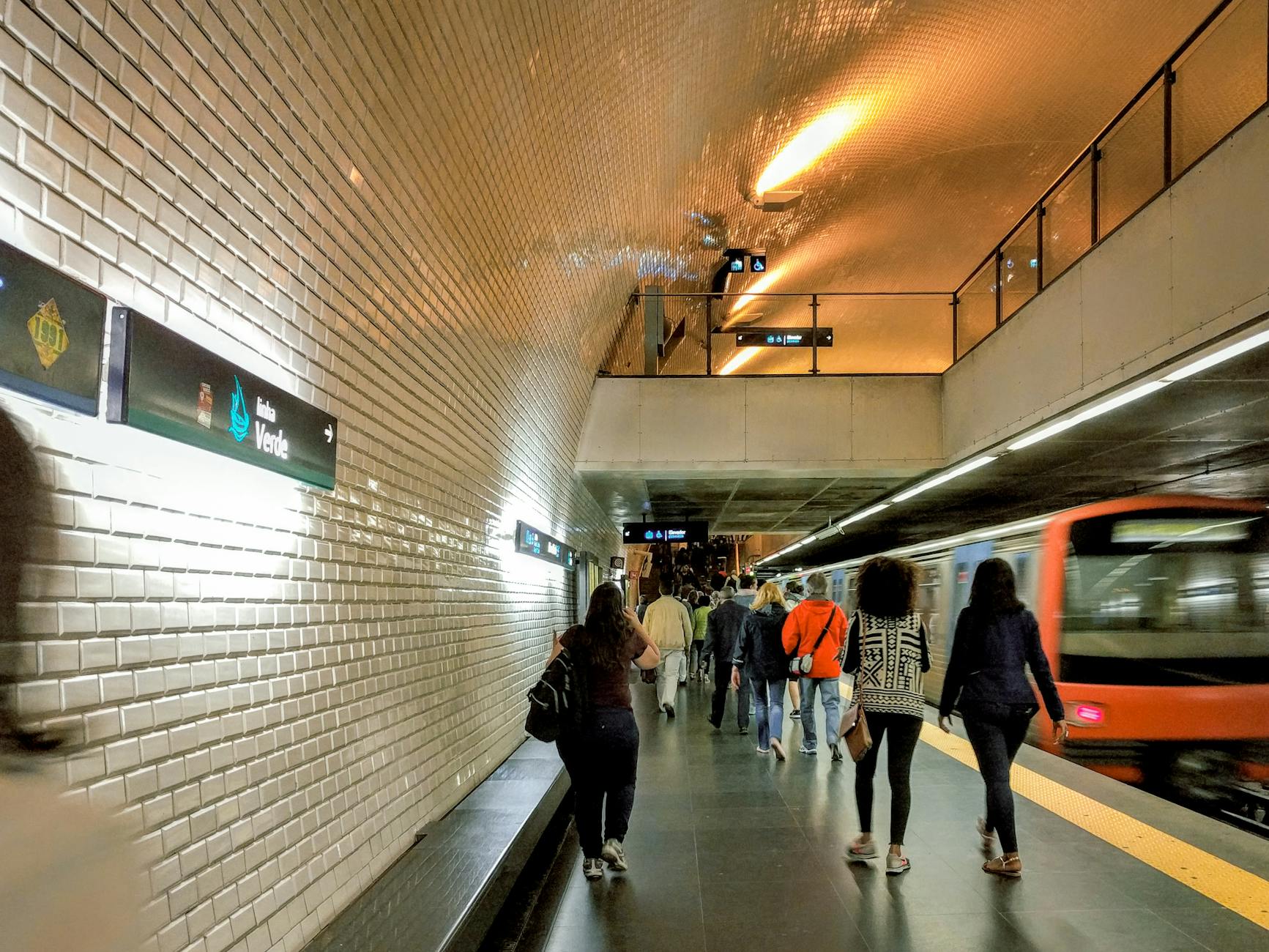
Lisbon Metro at a Glance
- Lines: 4 (Blue, Yellow, Green, Red)
- Stations: 56
- Operating hours: 6:30 AM – 1:00 AM daily
- Frequency: Every 5–9 minutes during the day, every 9–15 minutes evenings
- Single fare: €1.90 (Navegante card) / €1.92 (contactless bank card) / €1.72 (zapping)
- 24-hour pass: €7.25 (covers metro + buses + trams)
- Card: Navegante card €0.50, reusable
The Four Lines
Blue Line (Linha Azul) — Reboleira ↔ Santa Apolónia
The east-west diagonal, runs from western Reboleira through Marquês de Pombal to the historic core (Restauradores, Baixa-Chiado) and onward to Santa Apolónia (Lisbon’s main intercity train station). The most useful single line for tourists.
Key stations: Marquês de Pombal (interchange with Yellow), Avenida (Avenida da Liberdade), Restauradores (Rossio Square), Baixa-Chiado (interchange with Green; gateway to the historic core), Terreiro do Paço (Praça do Comércio), Santa Apolónia (intercity trains).
Yellow Line (Linha Amarela) — Rato ↔ Odivelas
The north-south central spine. Runs from the western Rato neighborhood through Marquês de Pombal and the major commercial district to Odivelas in the north. Less directly useful for first-time tourists but valuable for getting to the Gulbenkian Museum (São Sebastião station) and the Eduardo VII Park area.
Key stations: Rato (Príncipe Real area), Marquês de Pombal (interchange with Blue), Saldanha (interchange with Red, business district), Campo Grande, Odivelas.
Green Line (Linha Verde) — Cais do Sodré ↔ Telheiras
Runs from Cais do Sodré (riverside, ferry terminal) north through Baixa-Chiado, Rossio, Martim Moniz (entry to Mouraria and the Tram 28 line), and on to Telheiras in the north. Very useful for tourists.
Key stations: Cais do Sodré (ferry to Cacilhas, Cascais line train), Baixa-Chiado (interchange with Blue), Rossio (Praça do Rossio), Martim Moniz (Mouraria, Tram 28 starting point), Alameda (interchange with Red).
Red Line (Linha Vermelha) — Aeroporto ↔ São Sebastião
The airport-to-city line. Runs from Humberto Delgado Airport east through Olaias and Alameda (interchange with Green) to São Sebastião (interchange with Blue) on the western side. The line you’ll likely take from the airport.
Key stations: Aeroporto (the airport, eastern terminus), Alameda (interchange with Green), São Sebastião (interchange with Blue), Saldanha (interchange with Yellow), Oriente (Parque das Nações district, Oceanarium).
For getting from the airport to the city, see our Lisbon airport to city center guide.
The Navegante Card (Formerly Viva Viagem)
The Navegante card is the standard reusable smart card for Lisbon’s metro, buses, trams, ferries, and suburban trains. It costs €0.50 to buy (one-time purchase) and can be loaded with various ticket types.
How to Buy
Vending machines at every metro station entrance. English menus available. Accepts coins, banknotes, credit/debit cards, and Apple/Google Pay. The process:
- Press “Buy Card” or “New Card”
- Choose the ticket type you want loaded onto it
- Pay (typically €0.50 for the card + your chosen ticket)
- Take the card and the receipt
- Tap the card on the yellow reader at the gates to enter
Ticket Types You Can Load
- Single ride: €1.90 (one trip on metro, bus, or tram)
- Zapping credit: Pre-loaded balance, charges €1.72 per ride. Best for moderate users.
- 24-hour pass: €7.25, unlimited rides for 24 hours from first use
- 72-hour pass: €18.50
Important Notes
- One card per person. You can’t share a Navegante card; each person needs their own.
- The €0.50 card cost is one-time. Reuse the card on subsequent trips. Keep it for return visits to Lisbon.
- Cards expire after 1 year of inactivity. Use it once a year and it stays valid.
- Contactless bank cards work directly at the gates (€1.92 per ride), but the Navegante system gives you cheaper zapping rates and clearer pass options.
Single Ride vs Day Pass: Which to Choose
Buy a 24-hour pass (€7.25) if you’ll take 4+ rides in a day, especially if you’re combining metro with trams (Tram 28 alone is €3 single).
Use zapping (€1.72/ride) if you’ll take 2–3 rides in a day. Pre-load €5–€10 of credit and the system deducts as you go.
Buy single rides (€1.90) only if you’re taking 1 metro ride and won’t use buses or trams.
Consider the Lisboa Card (€27/24h) if you’ll also visit 3+ ticketed attractions. Includes unlimited transit + free entry to ~50 sights.
How to Use the Metro
Entering
Hold your Navegante card flat against the yellow reader. Wait for the green light and the gate to open. Push through. The system records your entry station.
Transferring
At interchange stations (Baixa-Chiado, Marquês de Pombal, Alameda, São Sebastião), follow signs to your destination line. Most transfers involve a 2–4 minute walk through connecting tunnels. No additional ticket charge for transfers within the metro system.
Exiting
Tap the same card on the yellow reader at the exit gate. The system records your trip and (if using zapping) deducts the appropriate fare.
Buses and Trams
Same Navegante card works on Carris buses and trams. Tap the yellow reader at the front of the bus when boarding. Don’t forget — failure to validate is a fine of €60 or more.
Metro Stations Worth Knowing
Aeroporto
The airport metro station, eastern terminus of the Red Line. Direct connection to Terminal 1; 5–7 minute walk from baggage claim. Operating hours 6:30 AM – 1:00 AM.
Baixa-Chiado
The most important interchange in the system, connecting Blue and Green lines in the heart of the historic core. Two exits — one to Baixa (the lower, grid-pattern district), one to Chiado (the elegant uphill shopping district). Both put you within 2-minute walks of major attractions.
Rossio
Green Line station opening directly onto Rossio Square. Useful for hotel access, Sintra-line train station next door, and Rua Augusta walking access.
Martim Moniz
Green Line station at the entry to Mouraria district and the starting point for Tram 28’s most popular run. Famous for the multicultural neighborhood food court (Mercado de Fusão).
Cais do Sodré
Green Line southern terminus, riverside. Connection to the Cascais line train (to Belém and Cascais), Tagus ferries (to Cacilhas), and Time Out Market 90 seconds away.
Marquês de Pombal
Major Blue/Yellow interchange under the giant traffic circle of the same name. Useful for Avenida da Liberdade hotel district access.
São Sebastião
Red/Blue interchange on the western side. The closest metro to the Calouste Gulbenkian Museum (8-minute walk).
Oriente
Red Line station at Parque das Nações district. Built for Expo ’98, designed by Santiago Calatrava. The closest metro to the Lisbon Oceanarium, Vasco da Gama Tower, and the Web Summit conference venues.
The Famous Metro Art
One of Lisbon’s underrated cultural experiences: the metro stations are decorated with extensive azulejo (tile) installations and contemporary art, designed by leading Portuguese artists. Highlights:
- Olaias (Red Line) — colorful explosion of cylindrical pillars and geometric tiles by Tomás Taveira; widely cited as one of Europe’s most beautiful metro stations
- Parque (Blue Line) — modernist tile installations by Maria Keil, who designed the original 1959 metro tile programs
- Cidade Universitária (Yellow Line) — academic-themed murals by Vieira da Silva
- Alvalade (Green Line) — early 1960s azulejo work by Maria Keil
- Baixa-Chiado (Blue/Green) — Álvaro Siza Vieira’s elegant interchange architecture, with subtle azulejo accents
- Oriente (Red Line) — multiple international artists commissioned for Expo ’98, including a striking Friedensreich Hundertwasser installation
- Olivais (Red Line) — playful contemporary art by Nuno de Siqueira
If you have an extra hour and a 24-hour pass, riding the metro specifically to view the art is a rewarding mini-tour.
Operating Hours and Frequency
Hours: 6:30 AM – 1:00 AM daily, every day of the year.
Frequency:
- Rush hours (7:30–9:30 AM, 5:30–7:30 PM): every 5–7 minutes
- Daytime: every 6–9 minutes
- Late evening (after 10 PM): every 9–15 minutes
Trains shorter at off-peak — about 4 cars long — vs full 6-car trains at rush hours.
Accessibility
Most newer Lisbon Metro stations have elevators connecting street level to platforms — particularly all Red Line stations and most Blue Line stations. Older Yellow and Green Line stations can be partially or fully accessible-by-stairs only. Notable stations with full accessibility: Aeroporto, Marquês de Pombal, São Sebastião, Oriente, Saldanha, Cais do Sodré.
The official Metro de Lisboa site has a station-by-station accessibility map. Check before traveling if you’re using a wheelchair or pushing a stroller.
Safety Tips
Lisbon’s metro is generally very safe — clean, well-lit, monitored by uniformed staff and security cameras at every station. Two cautions worth knowing:
1. Pickpockets. The metro lines through tourist-heavy stations (especially Cais do Sodré, Baixa-Chiado, and the Green Line through Mouraria) attract petty thieves who target distracted tourists. Keep wallets in front pockets, bags zipped and in front of your body, and avoid displaying expensive electronics.
2. Late-night travel. Service runs until 1 AM but the network is significantly emptier after 11 PM. Stick to busier interchange stations if traveling alone late at night.
For broader context, see our is Lisbon safe guide.
Common Tourist Mistakes
1. Buying single rides one at a time. The 24-hour pass pays for itself after 4 rides; zapping is cheaper if you’ll do 2–3.
2. Forgetting to validate at exit. Always tap your card at exit gates. Some stations have open exits but the validation is still required for accounting.
3. Forgetting buses and trams use the same card. One Navegante card covers all of Carris (buses + trams) plus metro. Don’t buy separate tickets for the tram.
4. Looking for the metro to Belém. There isn’t one. Belém is on the Cascais train line (from Cais do Sodré) or Tram 15E.
5. Ignoring the art. Olaias and Parque alone are worth a brief detour.
6. Carrying large luggage on rush-hour trains. Possible but unpopular. Travel with bags before 7 AM, between 10 AM and 5 PM, or after 8 PM.
Comparison: Metro vs Other Transit
| Mode | Best for | Cost |
|---|---|---|
| Metro | Long distances (airport, north/south, east/west diagonals) | €1.90 single, €7.25 day pass |
| Tram (especially 28E, 15E) | Scenic routes (Alfama, Belém) | €3 single, included in day pass |
| Bus | Hill access (Alfama, Castelo) and outer neighborhoods | €2.10 single, included in day pass |
| Cascais Line train | Belém, Cascais, Estoril | €1.45–€2.30 each way |
| Sintra Line train | Sintra day trips | €2.30 each way |
| Ferry | Cacilhas, Almada (south bank) | €1.45 each way, in day pass |
| Taxi/Uber/Bolt | Late nights, with luggage, hilltop hotels | €8–€15 typical city ride |
For broader transit context, see our Lisbon transportation guide pillar and our Lisbon trams guide.
FAQ: Lisbon Metro
How much does the Lisbon Metro cost?
€1.90 per single ride with a Navegante card, or €7.25 for an unlimited 24-hour pass that includes buses and trams. The Navegante card itself costs €0.50 (one-time).
What are the Lisbon Metro hours?
6:30 AM to 1:00 AM daily, with trains running every 5–9 minutes during the day and every 9–15 minutes evenings.
Does the Lisbon Metro go to the airport?
Yes — the Red Line (Linha Vermelha) terminates directly at Humberto Delgado Airport. The trip from the airport to central Lisbon (Baixa-Chiado) takes 20–25 minutes with one transfer.
Does the Lisbon Metro go to Belém?
No — Belém is not on the metro network. Take Tram 15E from central Lisbon, the Cascais-line train from Cais do Sodré, or bus 728 from Praça do Comércio.
Is the Lisbon Metro safe at night?
Generally yes. Service runs until 1 AM with security staff and cameras at all stations. Standard pickpocket precautions apply, particularly at busier tourist stations.
How do I pay for the Lisbon Metro?
Use a Navegante (Viva Viagem) card loaded with single rides, zapping credit, or a 24-hour pass. Or tap a contactless bank card directly at the gates (€1.92 per ride).
How do I transfer between metro lines?
Follow the signs at interchange stations (Baixa-Chiado, Marquês de Pombal, Alameda, São Sebastião). No additional ticket charge for transfers within the metro system.
Can children use the Lisbon Metro?
Yes. Children under 4 ride free with an accompanying adult. Children 4–12 pay reduced fares. Strollers fit easily on metro trains.
Is there a Lisbon Metro app?
Yes — the official Metro de Lisboa app provides real-time train arrival, station maps, and route planning. Google Maps also reliably shows metro routes.
How does the Lisbon Metro compare to other European metros?
It’s smaller than Madrid, Paris, or London (only 4 lines vs 12+), but cleaner, less crowded, and more reliable than larger systems. The famous metro art makes it more interesting than most.
Bottom Line
The Lisbon Metro is fast, clean, frequent, and easy to navigate once you understand the four-line system. Buy a Navegante card on day one (€0.50 + €7.25 for the 24-hour pass), use it on metro + buses + trams, and you’ll cover the city efficiently. The famous metro art is a free bonus. Combined with the trams, walking, and the Cascais train, the metro forms the backbone of getting around Lisbon — and you can use the same single card across all of it.
Continue planning transit with our Lisbon Transportation Guide pillar, our airport to city center guide, our Lisbon trams guide, and our funiculars and elevators guide.
Leave a Reply