The Belém Tower (Torre de Belém) is Lisbon’s most photographed building — a delicate, lacy 16th-century fortified gateway that watched a thousand voyages of discovery depart for India, Brazil, Africa, and the Far East. UNESCO World Heritage since 1983, alongside Jerónimos Monastery, the tower is the symbolic gateway of the Portuguese Age of Discoveries and the single most iconic image of Lisbon.
This guide covers everything you need to plan a great visit: tickets, opening hours, the current restoration closure status, what to see inside (and what to look for outside), the architecture and history that make it remarkable, and how to combine the tower with the rest of Belém. Updated for 2026.
Belém Tower at a Glance
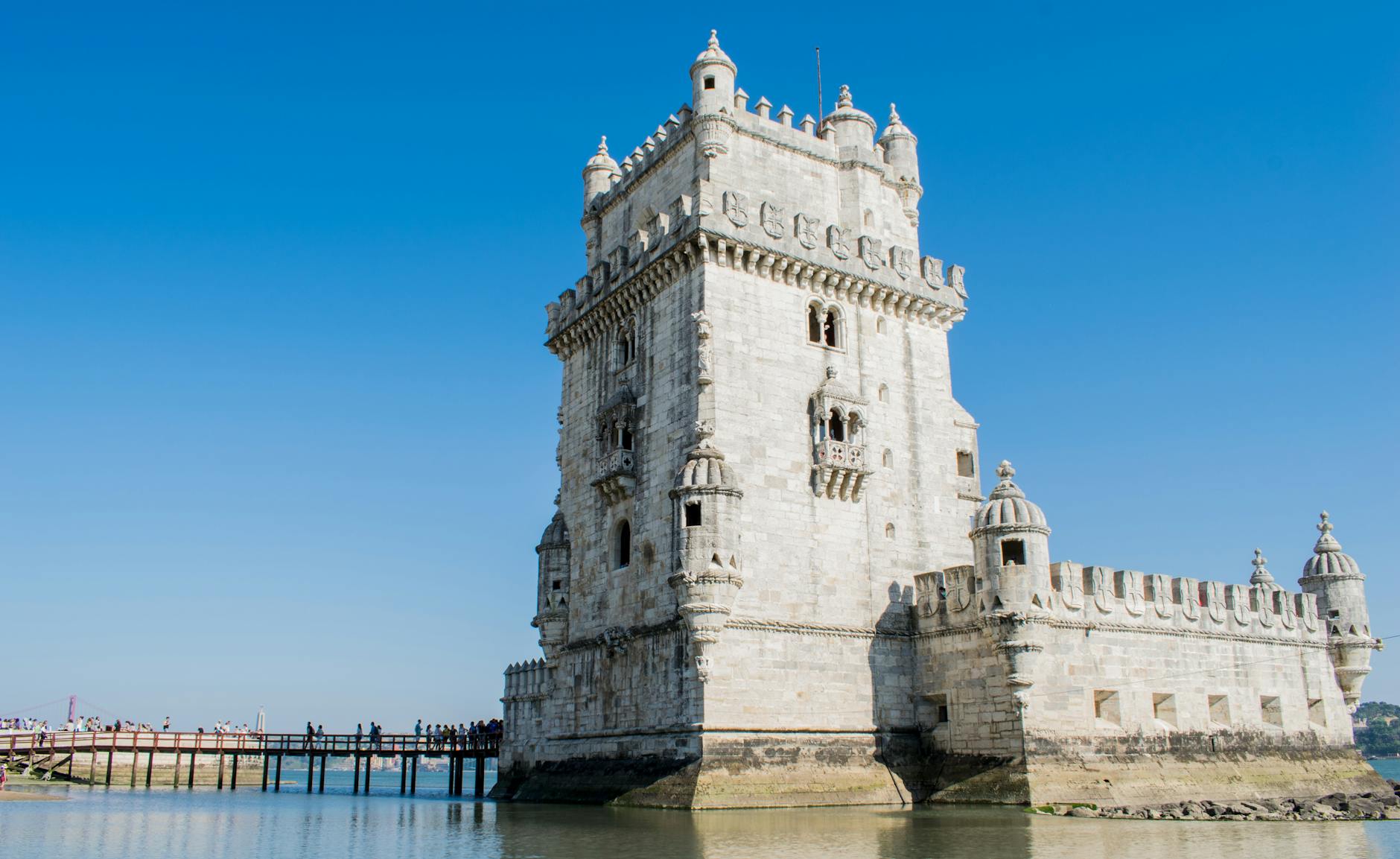
The Belém Tower stands on a small basalt outcrop in the Tagus River near the western edge of Lisbon, in the Belém district about 6 km from central Praça do Comércio. It was designed by architect Francisco de Arruda and built between 1514 and 1520 during the reign of King Manuel I, at the height of Portugal’s maritime golden age. The construction was funded by the same spice-trade taxes that paid for nearby Jerónimos Monastery.
The tower served three roles across its history: a defensive fortress guarding Lisbon’s harbor, a state customs house collecting duties on incoming ships, and — less proudly — a prison for political dissidents during the 19th and 20th centuries. UNESCO inscribed it on the World Heritage List in 1983 alongside Jerónimos Monastery.
Today it operates as a museum and historic monument under the management of the Direção-Geral do Património Cultural. More details on both UNESCO sites at UNESCO World Heritage listing 263.
Important: 2026 Closure Status
Confirm before your visit. Belém Tower has been undergoing major restoration work, with the interior closed to visitors. The reopening is expected in Spring 2026, but the schedule has slipped before. Always check the official Direção-Geral do Património Cultural site or call ahead before traveling specifically to enter the tower.
Even when the interior is closed, the exterior — which is arguably the more iconic view — remains freely viewable from the surrounding promenade and waterfront.
Tickets, Hours & Practical Info (When Open)
Opening Hours
Standard schedule when the tower is open to visitors:
- May 1 – September 30: 10:00 AM – 6:30 PM (last entry 6:00 PM)
- October 1 – April 30: 10:00 AM – 5:30 PM (last entry 5:00 PM)
- Closed: Mondays, January 1, Easter Sunday, May 1, June 13 (Santo António), and December 25
Ticket Prices
- Standard adult: €15
- Youth (13–24): €7.50
- Children under 12: Free
- Seniors 65+: €7.50
- Family pass: €25 (2 adults + 2 children)
Combination tickets — Belém Tower + Jerónimos Monastery joint admission is sometimes available for €22 (down from €36 separate). Check the official site.
Lisboa Card holders enter free.
Sundays before 2:00 PM are free for all visitors. Lines on free Sunday mornings stretch 60–90 minutes — usually not worth it.
Skip-the-Line
The tower’s narrow interior limits visitor capacity, which means queues can be brutal even with valid tickets. Three workarounds:
1. Pre-book a timed-entry ticket online via the official site or GetYourGuide. €15 for the standard ticket plus €2–€5 booking fee, with a guaranteed entry slot.
2. Arrive at 9:45 AM right before opening. Even on summer weekends, the first 30 minutes after opening have minimal queues.
3. Visit late afternoon (4:00–5:00 PM) when tour groups have moved on. The interior light is also at its best for photography then.
Avoid 11:00 AM – 2:00 PM — peak when cruise-ship excursions and tour buses arrive.
How to Get to Belém Tower
The tower is in Belém, the same district as Jerónimos Monastery, MAAT, and the Discoveries Monument. Most visitors combine all of these into one Belém day or half-day.
By Tram (Tram 15E)
The most scenic option. Tram 15E runs from Praça da Figueira/Praça do Comércio to Belém in 25–30 minutes. Get off at “Largo da Princesa” or one stop further at “Belém / Jerónimos” and walk 8–10 minutes west along the riverside promenade. €3 single or €1.80 with a Viva Viagem day pass.
By Train (Cascais Line)
Trains from Cais do Sodré to Belém station every 15–20 minutes; 7-minute ride. From the station, walk 12–15 minutes west along the river. €1.45 each way.
By Bus
Bus 728 from Praça do Comércio stops near the tower. 25–35 minutes depending on traffic.
By Foot from Jerónimos Monastery
The two are 12 minutes apart on the riverside promenade — a pleasant walk along the Tagus passing the Discoveries Monument and MAAT.
By Uber/Bolt/Taxi
€18–€25 from central Lisbon, 25–35 minutes. Useful only if you have luggage or mobility issues.
What to See Inside Belém Tower
The tower has six levels connected by a single narrow spiral staircase:
1. Bastion (Ground Level)
The fortified base of the tower, with sixteen casemates (gun emplacements) that once held cannons defending Lisbon’s harbor. Walk the perimeter to see the sea-level arrow slits and original cannon mounts.
2. Governor’s Hall
The first major floor, where the tower’s governor would have received visitors. Original Manueline ribbed vaulting overhead. Manueline rope-and-armillary-sphere details on the doorway.
3. Kings’ Hall
A larger reception room used for ceremonial purposes. Notable for its Renaissance loggia opening onto the river — one of the few Renaissance elements in an otherwise Manueline building.
4. Audience Hall
Smaller chamber with a fireplace and original 16th-century stone benches.
5. Chapel
A small private chapel for the tower’s residents. The original stone altar survives.
6. Roof Terrace
The reward for the climb. Spectacular 360-degree views over the Tagus, the 25 de Abril Bridge, the Christ the King statue across the river, and the Belém riverfront. The terrace is also the best vantage for studying the tower’s iconic Cross of Christ battlements with their distinctive shield-shaped silhouette.
Architectural Details to Look For
The tower is the most refined example of Portuguese Manueline architecture — small enough to take in at once, but dense with carved detail. Key features:
The Bastion’s Iconic Watchtowers
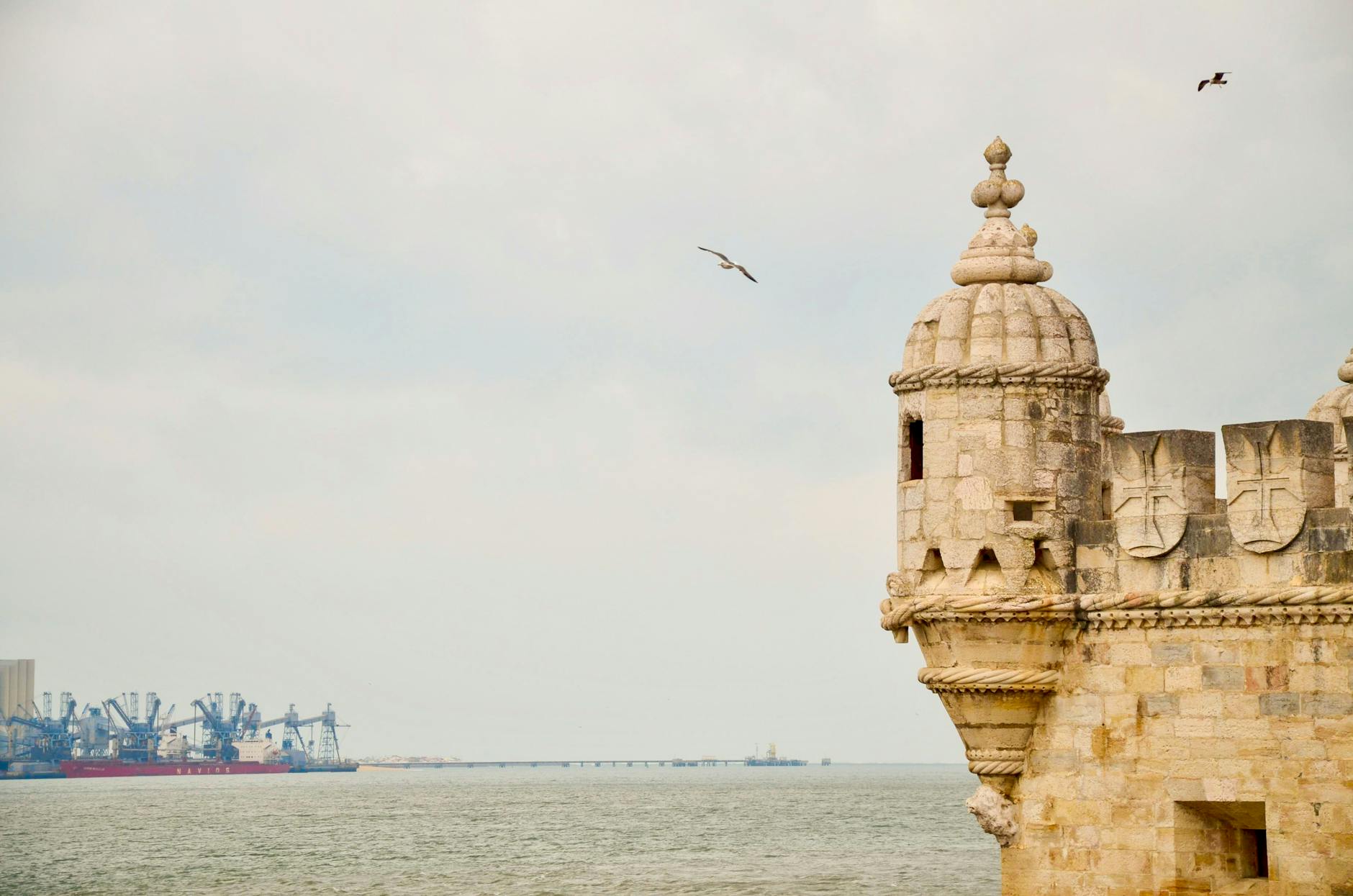
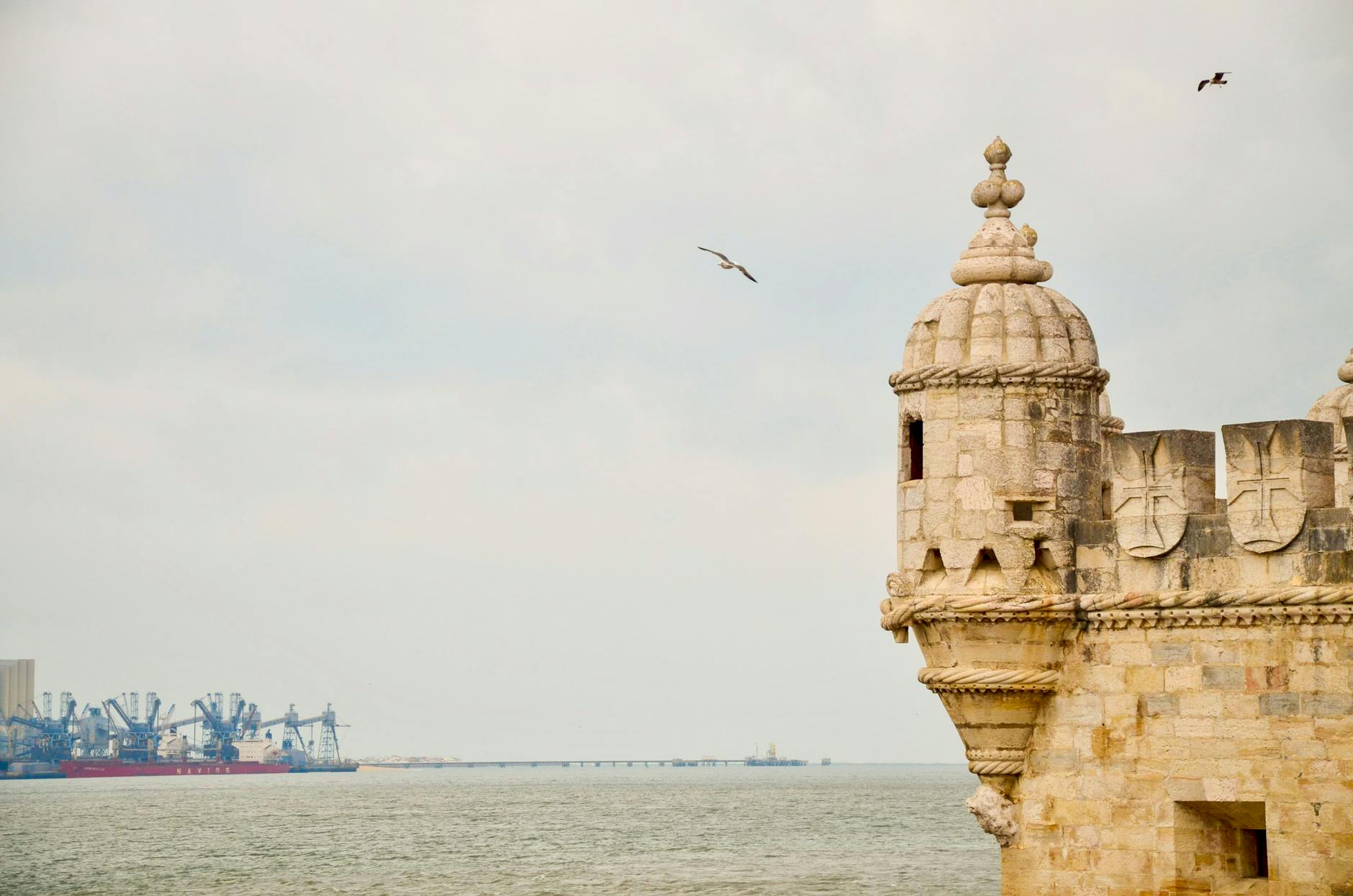
The four small turret-like watchtowers at the corners of the bastion are the most-photographed element. They look almost like the towers of a sand castle and are functional Manueline elaboration of standard military design.
The Cross of Christ Battlements
The shield-shaped battlements running along the bastion’s edge bear the distinctive cross of the Order of Christ — the red Templar-derived cross flown by Portuguese ships of the Age of Discoveries. Look for them lining the rooftop and the lower wall.
The Armillary Spheres
Carved wire-frame globes representing celestial coordinates — the personal symbol of King Manuel I — found on multiple decorative panels around the tower.
The Carved Ropes
Stone ropes twisted around windows and door frames — the Manueline reference to ship’s rigging. The tower’s south-facing main entrance has particularly fine examples.
The Rhinoceros
The most-cited curiosity: a small carved rhinoceros at the base of one of the western turrets, depicting an Indian rhinoceros gifted to King Manuel I in 1515 by the Sultan of Cambay (in modern-day Gujarat, India). The animal died en route to Pope Leo X in 1516; this carving and a famous Albrecht Dürer woodcut are among the earliest European depictions of a live rhinoceros.
The Loggia
The Renaissance arched loggia on the upper floors is the most visible non-Manueline element, reflecting architect Francisco de Arruda’s exposure to Italian Renaissance design via earlier Portuguese work in North Africa.
The Statue of Our Lady of Safe Homecoming
A small statue of the Virgin Mary in a niche on the northwest face, traditionally venerated by departing sailors who prayed for safe return.
The History — Why This Tower Exists
To understand why Belém Tower feels so distinctive, you need to understand its strategic and symbolic role.
By 1514, when construction began, Portugal was at the apex of European maritime power. Vasco da Gama had returned from India in 1499 with a cargo so valuable it remade Lisbon’s economy. Pedro Álvares Cabral had reached Brazil in 1500. Afonso de Albuquerque had captured Goa, Malacca, and Hormuz between 1510 and 1515. The Tagus River was Europe’s busiest international port.
King Manuel I, riding this wealth, wanted to project power through architecture. He had already commissioned Jerónimos Monastery in 1501 and now planned a defensive tower to guard the river entrance. The location was chosen carefully: a small basalt outcrop near the south bank of the Tagus, just upstream from Restelo Bay where ships departed for India. From this position, the tower could control all access to Lisbon’s harbor.
Architect Francisco de Arruda had previously worked on Portuguese fortifications in North Africa. He applied those defensive principles — bastions, casemates, low silhouette — but layered Manueline decorative elements on top, creating a building that was simultaneously a working fortress and a triumphal monument.
The tower was finished in 1520, just seven years before Manuel I’s death. By then, Portugal’s golden age was already starting to wane.
The Tower’s Many Lives
After its initial defensive role, the tower’s function changed several times:
16th–17th centuries — Used as a customs house, collecting duties on ships entering and leaving Lisbon. Government officials lived in the upper floors.
17th–18th centuries — Used as a state prison. The lower casemates held political dissidents during turbulent periods; conditions were notoriously poor — they could flood at high tide.
1755 earthquake — Like Jerónimos, the tower largely survived the catastrophic earthquake (located on stable bedrock, away from the worst seismic shaking). It needed only minor repairs.
19th century — Restored as a national monument. The Romantic-era Portuguese Crown invested in preserving the tower as a symbol of past glory.
20th century — Used briefly as a telegraph station. Restored multiple times. Inscribed as UNESCO World Heritage in 1983.
2010s–2020s — Major restoration work to address centuries of riverbank erosion, salt damage, and structural concerns.
Best Time to Visit
The shortest queues are at 10:00 AM (right at opening) and 4:30 PM (late afternoon). Avoid Sunday mornings (free entry creates serpentine queues), and avoid 11 AM – 2 PM weekday peak when cruise excursions arrive.
For photography, the tower is at its best from the riverside promenade in the mid-afternoon (golden light angles favorably from the southwest), and at sunset when the silhouette against the Tagus is unforgettable.
April–May and September–October offer the best balance of weather and crowds. See our best time to visit Lisbon guide.
Combining the Tower with Other Belém Sights
Belém is dense with major attractions. Most visitors plan a half- or full-day Belém loop:
9:45 AM — Jerónimos Monastery (1.5–2 hours). Start when queues are shortest.
11:30 AM — Pastéis de Belém takeaway counter (15–20 minutes). Eat warm in Praça do Império.
12:00 PM — Discoveries Monument (30 minutes) and giant compass-rose pavement.
12:30 PM — Lunch at Restaurante Enrique IV or SUD Lisboa (1 hour).
2:00 PM — MAAT (Museum of Art, Architecture & Technology, 60 minutes).
3:30 PM — Belém Tower (45–60 minutes inside if open; 20 minutes for exterior viewing only).
5:00 PM — Tram 15E or train back to central Lisbon.
If the tower interior is still closed, save 60 minutes and substitute the National Coach Museum or a leisurely riverside walk.
Photography Tips
Best vantage points:
- The wooden footbridge connecting the tower to the shore — classic frame with the tower in the middle
- The riverside promenade just east of the tower — best for the famous angled shot showing all four bastion turrets
- The grass lawn south of the tower — wider context shots
- Padrão dos Descobrimentos viewing platform (€10 admission) — the only elevated view of the tower from the east
Best light: Mid-afternoon (3–5 PM) for warm golden tones on the limestone facade. Sunset for silhouette shots facing west.
Tide considerations: The tower is most photogenic at high tide when water surrounds the bastion. Low tide exposes the muddy basalt outcrop. Tide tables for Lisbon are easy to find online.
Practical Tips
Bag policy: Large backpacks must be left at the entry. Small daypacks are fine.
Stairs: The tower has only one narrow spiral staircase connecting all six levels. It’s tight, alternates between up-direction and down-direction in 15-minute cycles, and is not wheelchair accessible. Visitors with mobility issues can see the bastion (ground level) only.
Photography: Permitted throughout without flash. Drones are not allowed.
Visiting time: 45–60 minutes is comfortable for the interior visit. Add 20–30 minutes for exterior photography.
Bathrooms: Limited inside the tower. Use the public restrooms at the riverside promenade or in nearby Belém cafes.
Children: Kids generally find the climb fun and the rooftop terrace exciting. The narrow staircase requires close supervision.
Belém Tower vs Jerónimos Monastery: Which Is Worth More?
If you only have time for one, Jerónimos Monastery is the deeper, more satisfying visit. It’s larger, structurally more complex, and the cloister alone delivers more architecturally than the entire tower.
That said, Belém Tower has the more iconic exterior and is the single most-photographed building in Lisbon. Even if you don’t enter, walking the riverside promenade to view the tower from the lawn is essential.
For a full Lisbon trip, do both. For a one-day visit, prioritize Jerónimos and admire the tower’s exterior on the way back from the Discoveries Monument.
FAQ: Belém Tower Lisbon
Is Belém Tower worth visiting?
Yes — it’s one of Lisbon’s two UNESCO sites and the city’s most iconic building. Most visitors rate it among their top Lisbon experiences. Even when the interior is closed for restoration, the exterior viewing is essential.
How long does it take to visit Belém Tower?
Inside: 45–60 minutes for a thorough visit. Add 20–30 minutes for exterior photography and walking the surrounding riverside.
How much does Belém Tower cost?
€15 standard adult ticket. Free for children under 12, €7.50 for youth and seniors. Free for Lisboa Card holders. Free Sunday mornings until 2 PM.
What is the best time to visit Belém Tower?
Right at 10 AM opening or 4–5 PM late afternoon. Avoid 11 AM–2 PM peak crowds. April–May and September–October are the best months for weather and crowds.
Where is Belém Tower located?
On the Tagus River in Belém district, about 6 km west of central Lisbon. Easy to reach by Tram 15E, the Cascais-line train, or bus 728.
What is the architecture style of Belém Tower?
Manueline — Portugal’s distinctive late-Gothic style featuring maritime motifs (ropes, ships, armillary spheres, the Cross of Christ) and Renaissance arched loggias. The tower is one of the world’s finest examples.
Is Belém Tower the same as Jerónimos Monastery?
No, but they’re nearby UNESCO sites typically visited together. They’re 12 minutes’ walk apart on the riverside promenade.
Can you see Belém Tower for free?
Yes — the exterior is freely viewable from the surrounding riverside promenade and lawn. Only the interior visit requires a ticket.
Is Belém Tower wheelchair accessible?
The bastion (ground level) is partially accessible. The upper levels are accessed only by a narrow spiral staircase and are not wheelchair accessible.
What was Belém Tower used for?
Originally a defensive fortress (1520–1700s), then a customs house, then a state prison, briefly a telegraph station, and now a UNESCO-listed museum and monument.
Bottom Line
Belém Tower is Lisbon’s signature image — a small, refined Manueline masterpiece that’s simultaneously a fortress, a customs house, and a monument to the Age of Discoveries. Pre-book skip-the-line tickets when the interior is open, arrive at 10 AM, allow 45–60 minutes inside plus extra time for exterior photos, and combine with Jerónimos Monastery and the Discoveries Monument for a complete Belém day. Even if the interior is temporarily closed for restoration, the exterior remains one of Lisbon’s essential stops.
Continue planning Belém visits with our Things to Do in Lisbon pillar guide, our Jerónimos Monastery guide, our São Jorge Castle guide, and our Lisbon viewpoints guide.